 |
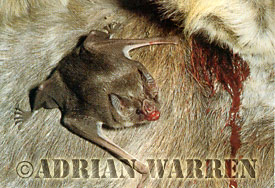
Vampire Bat, Desmodus, feeding on a donkey |
All over the world there are legends about bloodsucking vampires, legends that can be traced through history as far back as the ancient Egyptians and Romans, and are a result of man's preoccupation with death and the supernatural. But in Central and South America, many thousands of miles from Dracula's castle in Transylvania, there are bats that turn grisly legend into cold fact. In parts of the West Indies, country folk believe that they can protect themselves against a supernatural being that drinks blood by sprinkling grains of rice close to windows and doors. The legend goes that before the creature can attack it must pick up every grain - by that time it should be dawn and, as everybody knows, by cock-crow, all vampires must return to the safety of their lair. The legendary West Indian vampire is usually an old woman who, at night, turns into a bat. The very meaning of the word 'vamp' is a woman: an adventuress who exploits men. According to a New York psychiatrist who studies fears and phobias, the evil image shared universally by bats can be linked to old women who try to dominate their men; the kind of woman, one supposes, often referred to as an 'old bat'. Strange, then, that Count Dracula was a chap.
It is curious that the vampire myth, even today, continues to hold public imagination. Count Dracula has appeared in over two hundred films from at least ten countries, as well as in plays, books, comics and on television. Bram Stoker's novel "Dracula" has never been out of print, and commercial merchandising includes package holidays to Dracula's castle in Rumania led by an "occult"guide. The story source for Stoker's novel was said to be Vlad Dracul, a 15th century ruler of the Transylvanian province of Wallachia. He apparently had over 23,000 people impaled on wooden stakes, and used to eat his meals while watching their agony. He was a sadist, and a mass murderer, yes, but no vampire.
There was a vampire woman, however: an Austrian Countess - Elizabeth Bathony, a society beauty of the Imperial Court. As her looks faded with age, she imagined that the blood of young girls might keep her youthful and, over a period of 15 years, murdered some 600 of them in torture chambers of remote Carpathian castles, draining them of their blood for the sake of her vanity. Her accomplices were sent to the stake in 1611 but because of her high birth she was walled up in her chambers with a hole for air and food. She died three years later.
At the cost of our little South American vampire friends, the Dracula business is bound to live on as long as people's superstitions carry it. People, it seems, love to believe in things that go bump in the night .
The West Indian legends, in Trinidad at least, must occasionally be reinforced by the odd person who gets bitten by a true vampire, a small brown bat about 100 mm (4 in) long that feeds exclusively on blood, usually of animals rather than that of people. These little bats were not, as is popularly supposed, the model for Dracula: it was the other way round.
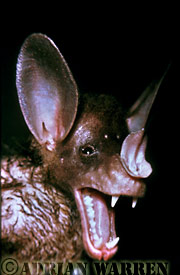 |
False Vampire, Vampyrum spectrum |
When European explorers first arrived in South America, they were fascinated by the blood-feeding habits of these bats and christened them 'vampires' after those restless souls from Transylvania who rose from their graves on dark nights.
In fact, as a result, all bats have suffered from bad press and the stigma of Dracula ever since. True, they are angular, leathery and hang upside down, and most only come out at night; however, not only are the majority of bats harmless, but they help us in important ways by controlling insect populations, and, in some parts of the world, by pollinating plants. When the blood-feeding habit in South America was first connected with bats, people blamed the wrong species, the giant spear-nosed bat Vampyrum spectrum - quite understandable, since it is the largest bat of South America with a wing span of nearly 90 cm (3 ft), but it is in fact a meat-eater, often feeding on smaller bats than itself, which it catches on the wing. It does not drink blood.
False Vampire, Vampyrum spectrum
There are three different kinds of true vampire bats: by far the most common is Desmodus which feeds mainly on the blood of mammals; Diaemus, somewhat rarer and preferring birds as prey; and finally Diphylla, a rare bat about which hardly anything is known and which differs little from its cousins except that it has very hairy thighs. One thing they have in common with each other is that they are just as at home on the ground as in the air; most bats, if put on the ground, flop around awkwardly with their wings half spread and have difficulty in taking off. Vampires, however, have elongated forearms and are extremely muscular; with wings neatly tucked in, they can run on the ground with ease and at great speed. When taking off they spring high into the air before spreading their wings for flight. The ability to run on the ground is of great value to vampires, allowing them to locate their prey on the wing then land at a safe distance, finally approaching from the ground. It also enables the bat to escape effectively after feeding when it may be too heavy with blood to fly.
Given that these bats only operate on the darkest nights, live in dark caves and carry potentially dangerous diseases like rabies, a 'private life study' of the vampire was a somewhat difficult assignment for a film. Understandably, when the idea was put forward it was met with scepticism and uncertainty, although with sufficient enthusiasm to approve an experimental filming trip to try to obtain a sequence of vampires feeding. No consideration at that stage was given to the problem of showing such a grisly spectacle on television; we did not even know if we would be able to film anything at all. Choice of location was important; if we chose the wrong one we might sit for ten days and not see a single bat. Trinidad seemed to offer the best opportunities, not because there are necessarily more vampires there than anywhere else but following serious outbreaks of rabies there in the 1950s and '60s, a bat control group had been formed to monitor vampire populations and attacks on domestic stock. Consequently all the major vampire roost were well known.
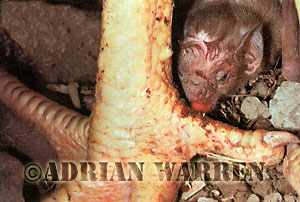 |
Vampire Bat, Diaemus, feeding on a chicken |
For our base in Trinidad, we decided to use an abandoned research station in the Arima valley in the northern range of attractively forested mountains. The station had originally been established in the 1930s by Dr. William Beebe for the New York Zoological Society and had good facilities for keeping bats for observational purposes: indeed, much of the important original research work on bat radar, or echolocation, had taken place there. The building had been deserted for many years but some renovation had begun prior to its being reopened for use by field biologists. But it was still charmingly ramshackle with creaky doors, cobwebs, old brass beds and its own colony of fruit bats in the house, which flew through the main hall at dusk and at dawn: a suitable, and spooky, setting for a film about vampires.
The next problem was to find a friendly farmer with animals under regular attack. This was not easy: like their supernatural cousins, vampire bats tend to home in on some individuals but leave others mysteriously unmolested. Farmers with great numbers of cattle and other livestock were of no interest to us since it would have been to difficult to isolate, for filming purposes, an individual attack. We needed to find a farmer with a smallholding, but most are careful to seal off their precious animals at night to protect them. However, we eventually managed to find a donkey that was being attacked almost nightly in an open stall. For several nights nothing happened; it seemed that while our presence was of obvious benefit to the donkey, our hopes of filming the vampires were beginning to fade. During our nightly vigils we would switch on the lights from time to time to see if anything was happening and we could only presume that this was creating sufficient disturbance to keep the vampires away. What we had not considered was the moon. So far the nights had been clear and brightly moonlit; on these nights vampires stay in the shadows, attacking prey in dark shelters or in the forest.
On the first overcast night at the donkey's stall, it all happened, and it took us completely by surprise. A dark shape had moved in towards one of the donkey's hoofs. When we switched on the light, it scuttled back into the darkness but to our delight came back again, at first slowly and cautiously, but then more purposefully. We were working with very low light levels and Martin Saunders, the cameraman, was only just managing an exposure with a very fast lens. As the bat moved in, Martin started the camera. Later that same night we filmed a second vampire attacking the donkey's ear. At four o'clock in the morning we returned to the creaky old house in the mountains bursting with satisfaction at having something on film, we hoped. If it proved to be technically good then this was the first time that vampires had ever been filmed feeding on a victim. The following night we returned again to try for more; and again we were lucky: the bats came and this time we were able to observe their technique more closely.
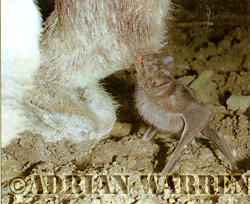 |
Vampire Bat, Desmodus, feeding on a donkey's ankle |
Before actually biting, the vampire often spends several minutes at its chosen site, sniffing and licking. The bat's saliva contains a mild anaesthetic so that the bite might be relatively painless. The long fangs, the canine teeth so characteristic of the fictional Dracula, apparently enable the bat to shave some of the hairs at the chosen spot. Then it bites, using its razor-sharp incisor teeth to make a shallow scoop in the flesh and discarding the small piece of skin it has removed. The donkey appeared to be aware of the bite but not particularly worried. It shifted its hoof as if shrugging off a persistent insect and the bat hopped backwards out of the way before moving in again to lap the blood that was gently flowing from the wound. Our lights, which were now on continuously, enabled the donkey, on occasion, to catch sight of the vampires as they scuttled in; at that he would shift nervously but most of the time he stood quietly. Once the bat was feeding, Martin was able to creep slowly in with the camera until finally he was only inches away from the bat using close-up attachments on the lens. The feeding would continue for as long as 40 minutes, the blood kept flowing by an anti-coagulant in the bat's saliva. In fact for quite a while after the bat staggered off with its belly full, the blood continued to flow; for such a tiny wound the loss of blood was large and for a smaller animal might have serious consequences to its health, but an animal as large as a donkey would have to be bitten a great many times to suffer as a result of blood loss. More serious is the threat of rabies, the virus of which is carried and transmitted through the bat's saliva. The work of the Trinidad bat group is to keep the vampire population down to a manageable level, destroying troublesome roosts and sampling others continuously to test for rabies. The statistics suggest that today, only one in two hundred vampires is likely to be a reservoir for the disease. The thought certainly crossed our minds that perhaps we should be chasing the bats off the donkey rather than settling to film the spectacle in all its grisly detail, but the donkey survived, and the owner constructed a vampire proof stall. It is difficult to admire any animal that feeds on another's blood, but perhaps that is not very logical. After all, we have considerable regard for countless other cruel predators like lions.
 |
 |
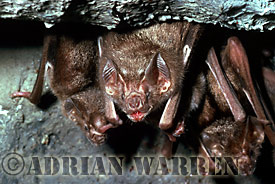
Vampire Bat, Desmodus, roosting |
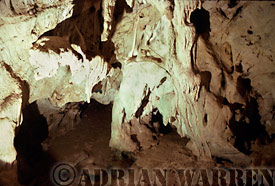
The Vampire Cave |
Over the weeks that followed the filming of the feeding vampires, we began to view these bats very differently and even respect them in a curious way. The bat control group showed us several roosts to choose from for filming the next sequence, the vampires 'at home'. One was a spectacular limestone cave hung with stalactites and with deep chimneys in the ceiling. It was in the dark recesses of these chimneys that the vampires lived, hanging upside down from the rock in dense clusters. Feeding on blood may seem a squalid habit but the vampire is, like most bats, a sociable animal and keeps itself scrupulously clean, a large proportion of its time being spent in grooming, using the sharp claws of the feet for combing the fine fur. The fur is so fine that the Inca emperor Atahualpa in the sixteenth century is said to have had a cloak made solely from the skins of vampires. Even when excreting, the vampire meticulously pushes its body away from the cave wall in order not to soil itself. That was the unpleasant part for us standing underneath in a constant rain of bat excrement, which collected in pools on the cave floor. Unlike the guano of other bats, that of vampire is black and smells strongly of ammonia: two sure signs of a vampire roost. Not much, you would think, could live in the black pools that looked like sticky treacle, but we found several tiny creatures there.
Although the vampire's eyes are larger than those of many South American bats, they are of little use in dark caves so they use a kind of radar or echolocation to orientate themselves with their surroundings. They are also able to recognize other members of the colony individually and communicate with one another using a series of different sounds in the high frequency range beyond human hearing. As well as sound communication, sniffing and grooming each other helps to form bonds between individuals. Courtship can be unceremonious, with the male often treating the female quite aggressively during mating. And afterwards, males play no further part in family life. A single young vampire is born after a gestation period of about two hundred days, nearly seven months. At birth it is only sparsely furred and blind; it uses hook-like milk teeth to cling tightly to the mother's nipple since, if it fell, it would certainly perish on the floor of the cave. When foraging, the mother usually leaves her infant behind in the cave where it is cared for by older youngsters and other females in a sort of nursery. There it is kept warm and safe and may even suckle from other nursing females if its own mother is away for a long time. The young vampire continues to suckle until it is nine months old, though during that time its mother will introduce it to a blood diet by first feeding it mouth to mouth, then by having it accompany her on sorties.
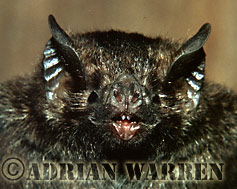 |
Vampire Bat, Desmodus |
Despite our increasing admiration for these little animals, our particular roost was destined for the chop. Local farmers had been complaining of more and more attacks on their livestock. The bat control group had tried putting drops of strychnine around the site of the wounds, working on the theory that vampires often return to the same host and the same wound night after night.
But this control method was not having a significant effect, so they tried a more lethal technique. The bats were caught in mist nets as they flew in to attack the farm animals; once one of the control team had removed a bat carefully from the net, another smeared petroleum jelly impregnated with poison on to its fur. The bat was then released to fly back to its roost. There, it begins to lick itself clean and so swallows the poison. Its companions, which always keep themselves so well groomed, come to help it clean up. So the poison spreads through the entire colony. The poison causes an internal haemorrhage and only a small amount is needed to cause death; it is estimated that for every bat caught, treated and released, as many as 20 others may die. The next day we visited the cave; of the 60 or so vampires we filmed only a few remained alive. The carcasses of the others littered the cave floor. We watched as the team collected the bodies and placed them in plastic bags; if they did not do so some innocent scavenging animal might have come to feast on the dead bats and also die of the poison. It was a control method frightening in its efficiency, but although humans are eliminating roosts around inhabited areas, small remote colonies in the forest continue to flourish. The fact is that before Europeans
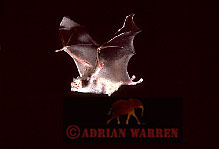 |
Vampire Bat, Desmodus, in flight |
colonized South America and brought their cattle, horses and chickens, vampire roosts were probably far less numerous than they are today. Domestic stocks are easy prey for vampires and allowed them to flourish to an almost unlimited extent. In the natural state, vampires were probably few and far between, feeding on monkeys, peccaries, tapirs, anteaters and the larger game birds such as curassows. The vampire's way of life could be called a marvel of evolutionary specialization; it has few enemies, it does not tear its living prey to pieces like many of the carnivores we admire so much. Indeed, it lives with great economic efficiency, only rarely killing its hosts; and were it not for the fact that, like our own much loved dogs, it occasionally carries rabies, it could justly be called relatively harmless. But the name it has inherited means that in the eyes of most people this little, meticulously clean creature is doomed for ever to be loathed as a supernatural harbinger of death.
(Approx. 3050 words)
©ADRIAN WARREN 1979
