"How can the Indians assume goodwill when we ferret them out so relentlessly? ... We approach them from the sky, the sphere which they do not control ... We are offering them unknown territory for known, a foreign land instead of home, dependency for self sufficiency, subjection to outside powers instead of resistance, and hunger where once there was plenty. (Quote from a Missionary, reflecting on his life)
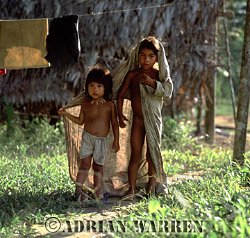 |
Waorani Indian children, rio Cononaco, 2002 |
For most of us, as individuals, life is defined by family and village; but on a grander scale, human migration, trade and the interpenetration of cultures are as old as the human experience. Globalization is not a phenomenon of the last decade, it is the human condition; as population increases, we need more room; the powerful relentlessly subdue the weak. Mankind has followed this universal pattern throughout history - whether in Europe, Asia, Africa, or the Americas. It is happening even now, in Amazonia; outsiders arrive, engulf, overwhelm, and consume, leaving a trail of irreversible destruction behind. It is a natural evolutionary process; it seems inevitable, and unstoppable.
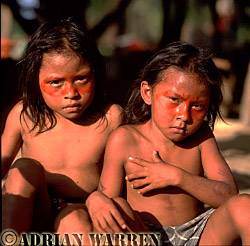 |
Waorani Indian girls, using Achiote for face decoration, rio Cononaco, 2002 |
The history of the Waorani of eastern Ecuador, and for that matter all of the Amazonian tribes, is sketchy, but first contacts with outsiders were often both tragic and violent. Records show that explorers arrived in the Amazon in the sixteenth Century, when Gonzalo Pizarro, brother of Francisco Pizarro who conquered the Incas, allowed some of his lieutenants to follow the river Amazon to its mouth. Of the hundreds of soldiers who set out on this perilous journey, only a few survived the debilitating diseases and hostile tribes they encountered on the way. For Indians who had never seen white people before it must have been a terrifying encounter, and they defended themselves against the unwelcome intrusion. For the soldiers, fierce looking Indians who could move silently through the undergrowth and strike without warning, usually at night, became formidable adversaries.
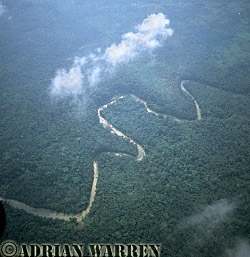 |
Rain Forest and River Cononaco, Ecuador |
In spite of the hostility of the environment and the Indians, more and more outsiders ventured into the Amazon; among the first were rubber gatherers, gold prospectors, and enterprising merchants. These men, eking out a hard life far from familiar home surroundings, often became unscrupulous, plundering villages, raping Indian women, enslaving young men, and murdering others. Many Indians died from diseases brought in by the strangers against which they had no resistance. It is no wonder that, for the Indians, outsiders were bad news.
The traditional lands of the Waorani lie in Ecuadorian Amazonia, where the foothills of the Andean Cordilleras flatten out to meet eight thousand square miles of tropical rain forest lying between the Napo and Curaray rivers. In the isolation of this remote territory, the Waorani have lived as semi-nomadic hunter gardeners for many centuries. But in the course of just one generation, their lives and their homeland have changed irrevocably.
(map in preparation)
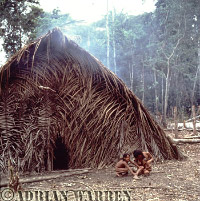 |
Waorani Traditional Hut, rio Cononaco, 1983 |
Exploration for oil began on the fringes of Waorani territory in the early 1940's, but the companies soon encountered great difficulties because of Waorani violence and hostility. In January 1942, at Arajuno, a Shell Oil Company foreman and two Ecuadorian workers were speared to death by a band of Waorani Indians, led by a man called Moipa. It made news headlines for a shocked outside world, but was only the first of many such raids by these uncontacted Indians. By 1949, a total of twelve Shell employees had been killed by Waorani, forcing Shell to abandon their operations. The Waorani had earned a reputation as a tribe of hostile 'savages', or in the Quichua language, 'Aucas'. It would be almost another decade before any peaceful contact would be made; only then would the outside world begin to understand the extraordinary and unique nature of the Waorani. It would be revealed that they were a desperate people living in fear, not just the threat from outsiders, but with a culture so embedded in violence that they were afraid of themselves.
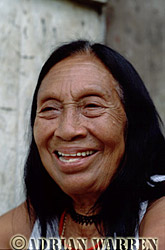
Soon after the Shell company killings, at the end of the forties, yet more tales of violence emerged. Two Waorani girls, Dayuma and Ome, chose to come out of the forest of their own accord, in order to escape a spate of vengeful spearing attacks and killings on their families by Moipa, the same man who had killed the oil workers. The girls fled the violence, throwing themselves at the mercy of the first outsider they came across. That outsider, Don Carlos, was the owner of a tea plantation, Hacienda Ila, and he took the girls to live as his slaves. Meanwhile, in the forest, the deadly vendettas continued, with killings and revenge killings. Moipa himself was eventually speared to death by other Waorani. Once accepted at Ila, Dayuma and Ome started doing manual work. Some time later, Rachel Saint, an American missionary from Wycliffe Bible translators, befriended them at the hacienda and started to learn their language. Little did Rachel know at the time that the consequences of her action would trigger a series of events that would change the lives of the Waorani forever.
 |
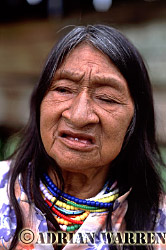 |
Dayuma, 2002 |
Ome, 2002 |
At the base of the Andes, where the mountains meet the Amazon rain forest, at Shell Mera, Rachel Saint's brother Nate, together with four other American missionaries, were making a plan to attempt peaceful contact with the Waorani. While aware of the tribe's fearsome reputation for killing all outsiders, they nonetheless felt compelled to try to take the Gospel to the free living Waorani. Realising that it would take many months of preparation, one of the men, Jim Elliott, decided to learn a little of the Waorani language beforehand, and joined Rachel Saint to work with Dayuma at Ila.
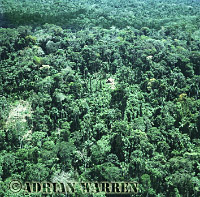 |
Waorani Traditional settlement, Dywetomi, 1983 |
Meanwhile, Nate Saint, a skilful pilot, devised an ingenious way of delivering gifts to the Waorani from his plane without landing. By banking his aircraft in a tight turn over a Waorani house, and once established flying in a tight circle, he would lower a canvas bucket containing presents on a piece of cord a quarter of a mile long. Due to centripetal force, the bucket would stay in the centre, allowing the recipients to safely approach and remove the contents. The first gift delivered by this method was a cooking pot with a lid, decorated with long ribbons, and containing brightly coloured buttons and some salt, was presented on 6th October 1955. The gift drops were carried out weekly, and on the 12th. November the Waorani responded by giving a present of their own; they tied a headband of feathers on to the line. This was seen as a breakthrough and an invitation, and plans were made for a contact expedition, to land a small plane on a sand bar the missionaries called 'Palm Beach' by the river Curaray, not far from the Waorani house. The Curaray is a shallow river with impressive meanders and extensive sand bars for much of its course, some of which are long enough to land a light aeroplane such as a Piper Family Cruiser.
