By Adrian Warren
(v) Free Fall; Parachutes; and Paragliders
Limited applications for aerial filming, demanding custom built camera mounts, and experienced operators.
(vi) Jets
The Lear Jet has been used quite frequently for IMAX filming, with the camera placed in the nose cone, a special and very expensive modification. However the Lear Jet has the advantage of speed and stability and not much restriction on altitude capability. Good if you have many thousands of pounds to spare per hour of flying time.
(vii) Space Shuttle
As used in IMAX filming; advantages of weightlessness, and for those high angles of Earth!
2. Rotary
Helicopters are very complex and inherently unstable. They require delicate and meticulous maintenance, and the rotors must be balanced, to make them perform adequately for filming purposes. The advantage of helicopters is that they can land almost anywhere, and are very manoeuvrable. But these advantages are traded for instability and vibration. Helicopters are not always available on location, and even if they are, they are expensive; many times more so than a single engined fixed wing aircraft per hour; and their range is limited, often requiring the organisation of fuel dumps prior to working in remote areas. The importance of stability for an aerial filming platform cannot be over emphasised; small helicopters and those with only two rotor blades tend to have serious vibration problems, so if you can afford it go for the larger helicopters with three, four, or even five rotor blades. Many of the problems associated with filming from helicopters can be reduced by using special, elaborate camera mounts; but beware of the blades intruding into shot at the top of frame when using wide angle lenses out of the door; when you are concentrating on the choreography and execution of a shot, it can be easy not to see the rotating blades in your frame, especially if the helicopter pilot is banking or trying to "crab" sideways - many a beautiful aerial shot has been ruined by this problem. Helicopters tend to slew, or "fish-tail", especially at slow speeds, or when flying close to the limit of their operational envelope. Beware of the hover too - in small helicopters it tends to be unsteady, and there is always the problem of down draught which will affect your subject matter, if you are filming close to the ground. Try to avoid filming during the transition from hover to forward flight (or vice versa) - when a helicopter is hovering or moving very slowly it is balancing on a cushion of air; as forward speed increases, the helicopter moves off the cushion of air and the rotating blades begin to obtain lifting power by moving into the relative wind. As they do so, they tend to shudder, causing vibrations that can produce unsteadiness in a shot. As mentioned earlier, normal vibration levels can be reduced by balancing of the blades properly - helicopters that do a lot of bush flying are susceptible to blade strikes by debris or tree branches. While small nicks in the blades need not necessarily compromise safety, they can increase vibration considerably. While the vibration limits may be acceptable to video work, 16 mm or even 35 mm filming, it may be too severe if you are considering large formats such as IMAX, where the sheer magnification of the image on to a very big screen also magnifies the unwanted vibration. At least in the case of large format, room should be made in the budget to have rotor blades checked and tracked with a strobe light and balanced with a Chadwick-Helmuth Vibrex system prior to shooting. It is well worth doing when you consider the cost of re-shoots. It is also worth remembering that no two aircraft can ever be the same, even if they are of the same make and model. One will always operate better than another. Even the best pilot in the world may not be able to coax a poorly performing aircraft to do what you want it to do in the smooth and fluid fashion you require for your perfect shot. Plan to execute shots, where possible, into the prevailing wind. A helicopter will not perform smoothly when flying downwind or cross wind, no matter how good the pilot is. While availability of aircraft types is usually the deciding factor on the kind of helicopter you end up using, it is worth remembering the basic practicalities - the larger the helicopter, the steadier it will be and there is more room to organise your equipment, while a small helicopter, such as a Robinson for example, is very cramped inside, and the skids of a Robinson are high and wide, making it quite difficult to execute vertical shots.
When working with helicopters, it is worth remembering a few safety considerations:
- When hovering or manoeuvring at low speeds near the ground, helicopters recycle the cushion of air that supports them; the down draught from the blades can cause debris to swirl upwards and become ingested in the rotor down wash. A simple piece of plastic, such as a waste bag can destroy a helicopter in seconds by wrapping itself around a rotor blade. The resulting imbalance renders the helicopter uncontrollable.
- Keep low when approaching or leaving a helicopter with the engine running; an unexpected gust of wind can cause the rotors to sweep close to ground level.
- Avoid the tail rotor; it is invisible when running. Make it a rule always to work around the front of a helicopter.
3. Lighter than air
There are many difficulties and disadvantages associated with the use of balloons for aerial photography, but when a balloon works successfully, the result can be visually very satisfying. It is the ultimate in smooth aerial platforms and there is no need to over crank the camera to smooth out bumps or aircraft vibration. There is also time to consider a shot more carefully, and there is the potential to fly low enough to skim the grass blades.
Now for the problems: Balloons are severely restricted by weather. It is difficult, and uncomfortable, to take off or land in windy conditions. In tropical areas, it can be dangerous to fly during the heat of the day when a turbulent thermal can toss the aircraft about alarmingly, or, worse still, suck a lot of the air out of the envelope. Balloons cannot choose where to fly - they go where the wind blows them, which not only means you can't go around for a second chance at a shot, but landing areas need to be planned well ahead of time. Balloons are not available everywhere, and, even where they are, they are expensive, and time consuming, requiring a ground crew with a vehicle suitable for the terrain and large enough to accommodate all the equipment. The difficulties in recovery in remote areas cannot be over estimated, either. And if you are planning to film animals from the air, a balloon is not the most suitable platform - they will run away from you as fast as they can if you are at low level, and if you go higher, there is always the possibility that the wind will carry you on a course that carries you and your balloon out of range of that huge herd of wildebeest that you thought you could not miss when you assessed the ground wind before take off.
If you simply want landscapes, and recovery is not a problem, then balloons can provide an exciting way of getting some interesting shots. Don't limit yourself, though, to placing the camera in the basket on a conventional tripod or clamped mount on the side of the basket. If you do, the camera will be too high for those dramatic ground skimming shots.
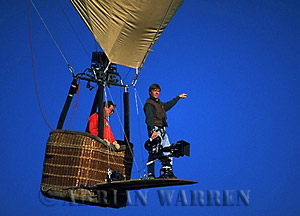 |
Balloon camera platform in Etosha, Namibia |
For the film ETOSHA, in "The Living Edens" series for ABC/Kane, we built a camera platform outside the basket which was hinged so it could be stowed neatly for take-off and landing; but, when deployed, provided a comfortably large enough surface to walk around on, with a 35 mm camera mounted on a high hat. The platform, made from marine plywood, was suspended from the balloon burner frame by thin steel cables, and more steel cables provided safety lines for both the camera and operator. If you would like further information on this technique, please contact us at Last Refuge Ltd.
4. Living Aerial Platforms
Camera harnesses on animals. Video cameras are now so small (no larger than a fingernail, including lens) and light enough to permit mounting on a specially designed harness for animals. Pictures from the video camera can be transmitted to a receiver. It should be noted, however, that this kind of activity can cause extreme stess to the animal concerned, unless it is specially trained for the purpose; and, in any case, the welfare of the animal should always be more important than your pictures. Special permits are required for working with animals.